Friday, July 9, 2010

On Babies and Baby Food

I was just reading through some old comments on my blog . . . which I am very bad about doing, by the way, and discovered that I offended my sister a few weeks ago by not mentioning my new niece who, according to my sister, wears cloth diapers and drinks organic milk. At first I was unsure about the organic milk part. My sister doesn't buy organic milk. She buys Kroger 2%, usually two gallons at a time, and sometimes throws a half gallon of chocolate milk into the cart too.

Right. But she makes plenty of organic milk at home. http://ellie-belly-days.blogspot.com/2010/06/i-was-right.html
Okay, maybe it isn't certifiably organic, since she might use antibiotics or take tylenol or other medications, but it's the real deal. No processing for Anna. Plus, it is 100% local. Who knew my sister (who recently read Michael Pollan's Food Rules - but just the bolded rules, not the descriptions - and commented "this is nice, but I'm not sure it works for for a family with toddlers.") was a locovore at heart?

Seeing this comment reminded me of a potential post I've been mulling over and trying to wrap my brain around. When I started this blog, I called myself a "locavore-in-training." I think it is official now. I am doing the best I can to eat locally whenever possible. Much to my husband's delight, I regularly go to the grocery store and come home with just four or five items - usually dairy - rather than a whole cartload of food. I just can't buy processed food anymore. I usually don't even buy produce at the grocery store, because it is summer and I can get all of the veggies I need (and then some) from local sources.

But some day my locovore shopping habits will probably have to change. Not in the very near future, but in a few years down the road, we plan to adopt a child. And she'll probably have to eat. The question is: what will our imaginary future adopted baby eat?

I don't think anyone in 2010 is unaware of the fact that there is a huge "breast is best" campaign out there. In fact, this campaign has grown so loud, powerful, strong, and pushy that some "bottle moms" are beginning to retaliate. I wasn't planning to blog this when I read the articles I'm about to mention, so I don't have any sources for you. Will you take my word for it this time, if I use plenty of qualifications such as: these words are mine, they are very rough paraphrases of stuff I read in a number of possibly credible and probably less-credible places, including some ticked-off mommy blogs?

There seems to be a new movement out there against nursing. I was at the doctor's office a few months ago and picked up a Parenting magazine (All of the patients at the Portage Clinic must be parents. I base this assessment on the fact that Parenting is the only magazine they offer in their waiting rooms, not on the fact that the day I was there the waiting room was full of several geriatric patients and myself). I think the title of the article included the phrase 'breast bully' and I thought it was going to be about nursing babies who are too pushy/demanding. The article was actually geared towards mothers who choose not to nurse their babies, for whatever reason, and mainly talked about how to deal with pushy nursing mothers who refuse to accept this choice. Until I read this article, I though the big debate over breastfeeding was still whether it was okay to do it in public. Apparently, the debate has shifted to a question of whether la leche league and its ilk ought to be making non-nursing mothers feel so badly about their lifestyle.

If I were to have a child in the usual way, I would plan to nurse that child, no question. But some mothers (like my own, for example) can't nurse - in our case, we were allergic to her milk. (A few days ago I read a blog by a woman whose son had been allergic to her milk. She said people asked her if she was an alien. How terrible.) I read a harrowing comment on a blog from a woman who desperately needed anti-psychotic medication that was not for use by breastfeeding mothers - and she had to make a choice between her own health and her child's. She was made to feel like a terrible mom by breast bullies. Some women have babies who don't take to nursing. Others - whose children will grow up to be my students one day - may nurse their infants for a few weeks but have to go back to work and find it difficult or impossible to pump during the work day. Is it fair for nursing moms to make these women feel so badly about something that is out of their control?

Here's where I wish I'd paid more attention to my sources. I read a long article from a magazine (online) that said that there is actually very little research to indicate that breastfeeding is better for a child's development. Apparently, even the studies that do show a difference between breast-fed and bottle-fed babies may not be based on sound research practices. Some of the studies do not adequately control significant variables such as the home environment -- which could have a lot more to do with brain development than the food a child eats. (Boy, did the breast bullies have comments to make about this article!)

On the surface, the breastfeeding debate does not seem to affect me at all. First and foremost, I don't have any children! Also, my girlfriends who are moms all seem to have taken to nursing easily and naturally. I get the sense that the hardest part for all of them was the eventual weaning. Other than my own mother, I don't know any moms who struggled so much with the choice of food for their babies. (And, by the way, my sister and I were also allergic to formula, so no one can blame my mom for not trying!) But as a locovore future adoptive mom, I have started to realize all the implications of this debate on my life in the years to come.

My reasons for thinking breastfeeding is (generally) better are more in line with what my sister had to say in her comment. Breast milk is 100% natural, you have complete control over what is in it, and it is the most local food in the world. Local, organic milk. For free. Delivered to you by nature. Mother nature doesn't even charge for shipping. (Okay, I'm minimizing the physical toll on the mother here, but I have no experience in that area and I've read descriptions of nursing that range from "pure hell" to "pure bliss" and "wonderfully convenient" to "completely inconvenient" and I'm afraid if I try to summarize what other people have gone through to nurse a baby I'll just end up offending everyone, which is not my intention at all!)

There are ways for adoptive mothers to stimulate their own milk production. Some involve taking hormones, which I can't see myself doing. (Where do they come from? What will they do to me? Would they be passed along to the baby?) Almost all involve supplementing with formula (unless you can actually trick your body into thinking it has gone through a pregnancy - which seems far-fetched). Most organizations who advocate for adoptive mothers to try to nurse their infants suggest that this be done not for the nutritional benefit to the child, but for the bonding experience. (See above where I mentioned variables not being considered during the breast v. bottle studies. This is one of them.) They also sell special packets of formula that fit in a holster around the mom so that the formula stays at body temperature. A small tube is used to deliver food to the infant while he or she is at the breast - no bottles are used. Are they in the stimulating milk production (which does not net them any profit) business, or the hormone, plastic tubing and formula (presumably highly profitable) business?

There are also ways for adoptive mothers to access breast milk from milk banks. I suppose this is the solution to my real food lifestyle. Except that I've read it can cost something like $32,000 a year for the milk. That is my entire non-existent salary! I don't think I'm going to add La Leche League to my grocery list any time soon.

So I'm stuck with formula for my not-currently-existent future child.

Why on earth would I want to feed my baby processed food that I won't eat myself? On the other hand, as one bottle mom pointed out in her blog, baby formula keeps babies alive! If the alternative to formula is nothing - and starvation, I'll go with formula every time.

It all boils down to this: I am probably going to end up being one of those moms who would really rather nurse her baby, but cannot. And I may face some severe bullying by other moms about my choice. I think I'll follow Michael Pollan's advice (again, my Food Rules book is now in Minneapolis so I don't have the page number, sorry). He says a person should be the kind of person who takes multivitamins, then skip the multivitamin. I will be the kind of mother who breastfeeds. Then I'll feed my adopted kid formula, because it's the most practical solution. (Or I'll start looking for donations of "liquid gold.")

Thursday, July 8, 2010

What's Cooking?

On Wednesday, as I mentioned, I went to Madison to do some gardening and stopped by the farmers' market. You've seen some of that haul. What I didn't mention earlier is that Wednesday is also our CSA pickup day. Michael was headed south for Scrabble Club, and offered to pick up our share (in DeForest) this week so I could get to book club on time. I didn't see the produce until late last night, but was excited to find:
4 more kohlrabi, including one that is purple (not pictured)
green onions
radishes
sage
four types of lettuce
peas!! (two bags!)

I love this picture. Yay Produce!
Earlier in the day I called Michael to see if he would please take a package of sausages out of the freezer for dinner. Not only did he take out the sausage, he also organized the freezer for me! Am I a lucky woman or what?

I invented a really cool dish late last summer that I blogged about here:
and I made it again tonight. The vegetable selection was different, of course, but the results were still good.

I used:
1 monster kohlrabi and one regular kohlrabi from my garden
All 4 zucchinis that I picked yesterday
2 onions from the garden (one yellow, one white)
2 cloves of early garlic from the farmers' market
2 tomatoes (1 lb) from the farmers' market
4 Jordanal sausages

Originally, I had planned to include the turnips, as a stand-in for potatoes, but decided to save them for the soup I plan to make tomorrow with my carrots and the rest of my onions. Instead of the turnips, I put all four zucchini in this pot. It made enough for at least four servings . . . and it is apparently good enough that Michael helped himself to a late-night snack of seasonal veggie stew a few minutes ago. (I just came up with that unoriginal but appropriate name - seasonal veggie stew - and I think it is a keeper.)
I'm pretty scared of under-cooked meat (even if it isn't from a CAFO) so I started cooking the sausages before I chopped any of the veggies.
kohlrabi (peeled) and zucchini
Just in case you're like one of those kids in Huntington, WV, as shown in Jamie Oliver's Food Revolution, who can't identify vegetables, this is onion and garlic (on the left) and tomato (on the right).
I drizzled a little bit of olive oil in this pan, let it heat up, then tossed in the kohlrabi and zucchini. Note to self: the zucchini doesn't need nearly as much cooking time as the kohlrabi. I already knew this, but I was being a lazy chef and had put them all in one bowl during the chopping process.
I let the kohlrabi and zucchini cook down a little, then added the onions and garlic . . . after they had a nice chance to mellow, I added the tomatoes. I could have added them sooner, but didn't want them to lose their color, which I thought they might.
Finally, when I felt certain the sausages were cooked, I sliced them up tossed them in, and let the whole thing simmer for a few minutes while Michael took Oliver for a walk and I finished making the salad.

I would have added basil, but my little basil plant in a pot out back is not doing very well. I think I damaged it when I pulled leaves off last week for a capreese salad. More on basil in a minute.

I made a salad with 3 of our 4 types of lettuce, green onions, raw kohlrabi, and radishes. We are out of the really yummy raspberry pecan salad dressing that we had been using on our strawberry salads earlier this summer, so Michael used honey mustard dressing. I decided to go for a drizzle of olive oil and balsamic instead, and loved it, and felt good about my non-local but less-processed dressing. Unfortunately I then adulterated my local salad by adding a little bit of feta cheese (which I could get locally but did not on this occasion) and kalamata olives (which will never be local, and have certainly seen their share of processing). Oh well, the salad was still excellent!
Finally, I made a loaf of yogurt rye bread today. I had considered making croutons with it, but decided against it for a few reasons. First, the last time I made croutons I actually made too many and ended up throwing a cup and a half away - which made me very sad. I was disappointed with myself for the waste. Second, I was already using the good crouton pot for my veggie stew. Third, I've only made croutons with home made french bread before. Normally I would not care what kind of bread my croutons were made from, but I'm still trying to get the hang of making bread in Wisconsin - with our variable humidity - and while my last 3 loaves (or more?) of French bread exploded in the bread machine (I needed to use tools to get the last 2 loaves out), this loaf of rye bread was a very squat, dense thing, and I wasn't sure it would make very good croutons. (It tastes excellent, even if it is squatty - I had a slice with strawberry jam for dessert.) Rather than croutons, we just had a slice of buttered bread with dinner.

Now, back to that basil. I can't believe I forgot to take pictures yesterday or mention it earlier! The main reason I went to garden in Madison yesterday was to "minimally process" my basil. I bought two little basil plants (and one parsley plant which has since been overtaken by the vine patch) at the farmers' market, and planted it among the tomatoes, according to some "Companion Planting" literature I found. It is really doing well! I have a book called "Grocery Gardening" by Jean Ann Van Krevelen that has some ideas about how to preserve produce. I'm not a huge fan of drying herbs (although the sage from our CSA is hanging upside down in the kitchen as I type) so I was delighted to read that it is actually more tasty to preserve basil by freezing it. Van Krevelen says, "Just toss your clean and dry harvested leaves into a blender with just enough olive oil to loosen the mixture. Then throw it into a freezer bag and pop it in the freezer. When you need basil for a recipe, just break off a piece and add; it will taste like you just harvested it" (Grocery Gardening, 42). I picked a (child's) bucket full of basil and I'd say it turned out to be maybe 3/4 of a cup of finished product. I could have broken off a piece and added it to my dish, but that seemed silly - the reason I put that basil in the freezer is to have basil in the winter when I don't have a plant growing outside.

When my mom and I planned to harvest some basil yesterday, I had *no* idea that all of that other produce would be ready too. The zucchini and green beans were a total surprise. We knew the turnips were ready but I wasn't sure if I should pick them yet - I thought they were supposed to be ready in the fall. I also checked on my potatoes, and was pleased to see that they are, in fact, growing - I didn't think they were last week. I covered them with more straw to make sure that they are not exposed to the light. I picked four cherry tomatoes, and was pleased to see quite a few large green tomatoes on the tomato plants. There are flowers on the pumpkin, cucumber, watermelon, and winter squash vines, as well as on the green pepper plant. Things are going to be getting busy in the garden in a hurry!

I actually took a few pictures of our wild, overgrown haven of a garden (in the downpour) but I could not get them to attach to a message in gmail, and they are now saved on my dad's computer an hour away. Stay tuned, maybe I will post them later.

Once Upon a Time . . .

I had a dog who helped me study for law school exams.

Those days are behind me now, but . . .


Thanks for the help with the puzzle, Oliver.

What's Growing?

I tried to post this yesterday, but I had trouble downloading the pictures back at the "farm" (my dad's garden) so I emailed myself, and promised I'd get around to it later. Then I had to rant about the Prevention Magazine advertisement last night, and didn't feel like taking several more hours to do another blog. So, without further ado, here's what I wanted to say yesterday:

The peas, earlier this summer:
The last batch of peas (although we may try to plant another crop for fall)
Safely tucked away in the freezer:

Last week I kept busy by picking, shelling, eating, and freezing peas . . . this week is going to be a different story! Michael and I spent the 4th of July weekend in Minneapolis enjoying good company, good food, and good music. Today it was time to head back to the garden. I discovered that my carrots are still not growing, but almost everything else is making up for it. The bush beans are ready to pick, although the pole beans, which were planted two weeks earlier, don't seem to be doing as well. They are climbing like crazy, but don't have any flowers or beans. I finally figured out a little bit about harvesting the onions. The ones with flowers (about a third) should to be picked now and eaten, because they won't store. The kohlrabi, which is completely overgrown (two are bigger than 7 inches across), still tastes very good, and I'll be making a bunch of it for dinner. The turnips are literally popping right out of the earth, but I picked 7 only to discover that four had been eaten by some kind of bug. Also, my zucchini are starting to mature. I picked four today, and will probably be dropping off squash at my neighbors' houses in the dead of night trying to get rid of it before too long - it's taken over the entire corn/bean/squash row!

Today's Haul (partial) I guess I didn't end up taking any pictures of the green beans . . .

(The top picture was taken with my dad's fancy camera, with the flash off, because the flash wasn't working for me in the kitchen - the pictures were coming out mostly white. The bottom picture was taken with Michael's Japanese camera, set to "cuisine" which he discovered during our honeymoon - which was a good thing because we took so many pictures of our food! I'm delighted with this setting for blogging purposes!)

Giant Kohlrabi (peeled and sitting in water because I didn't know what to do with it at the moment . . . my mom cut it up in spears and we dunked it in ranch dressing - yum)

Onions curing on my kitchen counter:


I was going to start pulling down the pea vines, in the hopes that we can get another crop in this summer, but then it started to pour, and I decided that job could wait.

I stopped by at the Hilldale Farmers Market in Madison this afternoon, but didn't bring much cash with me, so I had to pass on the raspberries ($3 or 4 a pint). I did get two tomatoes, some early garlic, and a bunch of purple carrots.

Note: I ended up eating plain yogurt with maple syrup for dinner before book club, then a snack of local popcorn when I got home. The kohlrabi had to wait . . .

Wednesday, July 7, 2010

The Lies my Health Food Told Me

I finished reading Fast Food Nation yesterday, and added two new blogs to my daily reads. (You can find links for them on the left.) This evening I opened my latest Prevention magazine and started flipping through the pages, ignoring all of the ads for diet foods making health food claims (my Food Rules book is on loan to my mother-in-law, so I don't know what rule that is but I got it from Michael Pollan) and then read this on page 51:

"Savor the Summer . . . Naturally." (Sounds good.)
"Summer cooking is all about yummy homemade treats. This summery recipe with some of nature's tastiest ingredients like pure honey, almonds, and sweet organic blueberries. Just simple, minimally-processed ingredients and nothing artificial. Enjoy!" (I'm interested.*)
"Blueberry Almond Bars
"Naturally delicious, these blueberry almond bars pack as much flavor as they do goodness.
"Ingredients (Makes about 18 servings)
"1 cup silken tofu, soft
". . .
"1/2 cup evaporated cane juice crystals
"3/4 cup plain organic soy milk
"1 Tbsp pure vanilla extract
". . .
"1 tsp pure almond extract (optional)
"1 cup Kashi (R) Heart to Heart (R) Blueberry & Oat Flakes Cereal
"1 cup Kashi (R) GOLEAN Crunch! (R) Honey Almond Flax Cereal
". . .

"Toppings
". . .
"1/2 cup cup Kashi (R) Heart to Heart (R) Blueberry & Oat Flakes Cereal
"1/2 cup Kashi (R) GOLEAN Crunch! (R) Honey Almond Flax Cereal"

etc.

*In tiny print across the top of the page, it reads "Advertisement" and there is a Kashi logo in the middle of the recipe, but the whole thing could be construed as kind of misleading in a health magazine filled with other non-commercial recipes (although I'm sure that legal battle has long been lost for the consumer).

What I find interesting about this advertisement is Kashi's use of the terms "minimally processed" and "nothing artificial." The italics above are mine.

Has it occurred to the Kashi writers that you simply cannot get tofu or soy milk without majorly processing soy beans? The ellipses included in the recipe indicate actual minimally processed, natural ingredients like eggs. I left out the oil, although it does say "expeller pressed canola oil" and that sounds like processing to me too . . . I wasn't sure what to think about the evaporated cane juice crystals - but yesterday I watched a video on YouTube where a doctor who slowly repeated himself and failed to use any hard facts to back up his statements spoke out against not just high fructose corn syrup but all refined sugar, pointing out that sugar, whatever its form, never appears so highly concentrated in nature.

I don't happen to have either of the Kashi cereals called for in the recipe in my house (all we have is a slightly stale box of plain Cheerios and a ton of oatmeal) but I do have a sample of Kashi Heart to Heart Warm Cinnamon Oat Cereal that I got as a free sample at the Taste of Minnesota last weekend. It can probably give a relatively good idea of what a consumer might find in Kashi's other cereals. Here is the list of (minimally processed? natural?) ingredients:
Whole oat flour, Oat bran, evaporated cane juice syrup, yellow corn meal, corn flour, Kashi (R) Seven whole grain flour (whole: oats, hard red wheat, rye, brown rice, triticale, barley, buckwheat), oat fiber, wheat germ, honey, cinnamon, salt, expeller pressed canola oil, natural flavor, decaffeinated green tea extract, alpha tocopherol acetate (vitamin E), decaffeinated white tea extract, baking soda, spices, ascorbic acid (vitmain C), activin (A trademark of San Joaquin Valley Concentrates) Grape Seed Extract, Luo Han Fruit Concentrate, beta carotene (a source of vitamin A), ferrous fumarate, Folic acid, pyridoxine Hydorochloride (vitamin B6), Turmeric for color, zinc oxide, vitamin B12.

Are you still with me? I believe that is 29 ingredients. (I did not count each of the types of flour individually, although I probably should have.) I just want to break this down a little bit further. There is a trademarked kind of grape seed extract in this cereal. I don't even know what Luo Han Fruit is . . .but here it appears in concentrated form. I imagine it would be pretty difficult to get decaffeinated tea extract without some processing. Something tells me that doesn't occur in nature.

Maybe you are wondering why I included the natural vanilla and almond flavorings in my list of irony. Here's Eric Schlosser on the topic:
"The distinction between artificial and natural flavors can be somewhat arbitrary and absurd, based more on how the flavor has been made than on what it actually contains. 'A natural flavor,' says Terry Acree, a professor of food science at Cornell University, 'is a flavor that's been derived with an out-of-date technology.' Natural flavors and artificial flavors sometimes contain exactly the same chemicals, produced through different methods" (Fast Food Nation, 126).

He gives an example: "Amyl acetate . . . provides the dominant note of banana flavor. When you distill it from bananas with a solvent, amyl acetate is a natural flavor. When you produce it by mixing vinegar with amyl alcohol, adding sulfuric acid as a catalyst, amyl acetate is an artificial flavor. Either way it smells and tastes the same." (126)

Okay, so the phrase "Sulfuric acid as a catayst" (126) makes me think I'll stick with the natural flavors. But Schlosser goes on to explain, "A natural flavor is not necessarily healthier or purer than an artificial one. When almond flavor (benzaldehyde) is derived from natural sources, such as peach and apricot pits, it contains traces of hydrogen cyanide, a deadly poison. Benzaldehyde derived through a different process - by mixing oil of clove and banana flavor, amyl acetate - does not contain any cyanide. . . . Natural and artificial flavors are now manufactured at the same chemical plants, places that few people would associate with Mother Nature. Calling any of these flavors 'natural' requires a flexible attitude toward the English language and a fair amount of irony" (126-127).

I have to admit, in my quest to re-create a diet of locally produced whole foods, I have not yet gone so far as to throw out the imitation vanilla extract in my cupboard. And I'm still buying brand-name whole wheat pasta at the grocery store. But come on, Kashi. Shame on you, and on Prevention Magazine and the Rodale group for playing with consumers this way. Corporations throw around these catch phrases to lure in new customers who, like me, are trying to become healthier citizens - choosing organic, non-processed foods to benefit the little guy. But Kashi is neither natural nor a little guy. Sure, big organics might have a place in the world, but it upsets me to think that they are tricking people into thinking that buying this stuff is just as good as supporting a local farmer who grows real food that is only processed in consumer kitchens.

For more on that, stay tuned for my next blog . . .

Friday, July 2, 2010

Edgewater Cup Soccer

While I was in Indianapolis enjoying my nieces, Oliver apparently developed a grudge against the entire sport of soccer, and took his frustrations out on his new toy. The battle must have raged for a while, because he looks pretty worn out here. I think Oliver won.

Settling into Summer

Barbara Kingsolver is always quoting or referencing Wendell Berry in _Animal, Vegetable, Miracle._ Okay, maybe not always, but frequently. The first time I read _Miracle_ I was excited by the references because I have a tenuous connection to Wendell Berry. Professor Graham included _Fidelity: Five Stories_ by Berry in the syllabus of the Law and Literature class I took during my second year. (This was my favorite class, by far. I know you're shocked.) Wendell Berry is from Kentucky and if I remember correctly, was an emeritus or adjunct professor at UK while I was there (but Wikipedia says he resigned from the faculty in 1977).

I was kind of disappointed, in 2005, to discover that _Fidelity_ was not a novel, but a collection of short stories, but I liked Berry's writing. Through Professor Graham's now mostly-forgotten lecture on Wendell Berry and my experience with his short stories, I knew I liked Berry. But when Kingsolver, and then Michael Pollan, started throwing his name around, I knew I needed to read more.

Consequently, I was delighted to learn last spring that my new book club would be reading a Wendell Berry book this summer. I didn't catch the title the first time, but later learned the book was _Jayber Crow_. A little investigation proved that the story was a novel, not a nonfiction piece on sustainable farming, as I'd been hoping, but I was still interested. Imagine my delight when, on page 183, I encountered this passage:

"Buying a tractor at that time was not unusual. A lot of people were doing it. The young men who had been in [World War II] were used to motor driven machinery. The government was teaching a new way of farming in night courses for the veterans. Tractors and other farm machines were all of a sudden available as never before, and farmhands were scarcer than before. And so we began a process of cause-and-effect that is hard to understand clearly, even looking back. Did the machines displace the people from the farms, or were the machines drawn onto the farms because the people already were leaving to take up wage work in factories and the building trades and such? Both, I think.
"You couldn't see, back then, that this process would build up and go ever faster, until finally it would ravel out the entire old fabric of family work and exchanges of work among neighbors. The new way of farming was a way of dependence, not on land and creatures and neighbors but on machines and fuel and chemicals of all sorts, bought things, and on the sellers of bought things - which made it finally a dependence on credit. The odd thing was, people just assumed that all the purchasing and borrowing would merely make life easier and better on all the little farms. Most people didn't dream, then, that before long a lot of little farmers would buy and borrow their way out of farming, and bigger and bigger farmers would be competing with their neighbors (or with doctors from the city) for the available land. The time was going to come - it is clear enough now - when there would not be enough farmers left and the farms of Port William would be as dependent as the farms of California on the seasonal labor of migrant workers."
Berry, Wendell. _Jayber Crow_. Counterpoint, 2000. p. 183. (I do not have the proper citation format for any single style memorized and am on summer vacation and did not look it up. Sorry.)

You might think this little essay on industrial farming is strange coming from the mouth of a 30 year old bachelor barber who was mostly raised in an orphanage, but Berry manages to blend it in with the rest of the narrative so that, if you weren't looking for it, you wouldn't even notice that the book had gotten very political all of a sudden.

I'm not finished with _Jayber Crow_ yet (our July meeting was canceled due to vacation plans, and the book was pushed back to August, so I have plenty of time to finish it) but it is a really good read and I will most likely be reading more of Berry's books - both fiction and nonfiction - in the near future.

Michael and I enjoyed our honeymoon, as you can tell in my previous post, but we did miss most of strawberry season and the best of the peas. The garden in Madison has gotten away from my dad and me a little bit this summer (I think the kohlrabi has gotten woody, tough, and inedible, I only ate our lettuce and spinach once or twice, and I missed the cherries completely) but I actually enjoyed picking several pounds of peas - and shelling some of them with Adele! (For some reason, she decided that the largest pods, and the big, round peas that were inside, were "Man peas" - cue deep two-year old voice. She could see that the man peas - and the mama peas, and baby peas - came out of the pea pods like her baby sister came out of mommy's tummy. She and I decided that the biggest peas of all were the Bapa (grandpa) peas. I have no idea where Man Peas and the deep voice came from, but they prove that I have the cutest niece ever. Luckily, Memaw got home from the store (with fresh-ish sweet corn!) in time to take a couple of pictures. Adele is a good helper and a good worker. I missed her help this morning when I had to shell all of my peas myself!


See how hard she was working - her little tongue is sticking out!

Adele is no ordinary girl - do you see her mermaid tail?

Anna Kate didn't help very much with the peas, but she was a little yellow-clad sweetheart.

I planted about seven or eight rows of peas this year, picked four times, and yielded 3/4 lb of shelled peas and 1.5 lbs of pea pods in the freezer, and another cup or so of shelled peas in Indianapolis, along with a small bunch, maybe half a pound in the pods, in my parents' fridge. There are still a few peas still on the vine, but they're basically done. We also have 3/4 of a pound of peas in the fridge from our CSA, which need to be shelled. I hope there will be more at the farmers market on July 10, because I love peas, and don't have enough to last through the winter right now!

I've discovered that I need more gardening advice. I have a book about gardening, my dad has several, and I've read the bulk of them - but they don't include enough information about Harvesting the darn produce. I've noticed that there are exacting, scientifically based (?) research-proven methods and calendars available to ensure that you plant all of your seeds in just the right manner, with the correct soil density and temperature, during the right phase of the moon, when the wind is blowing from the proper direction - but there is no information about when foods are ready to be harvested. Peas are easy to see and pick. Beans, beets, lettuce, spinach, tomatoes, winter squash, and pumpkins are also easy - we've grown/picked those before. The onions and potatoes are tricky. And the basil. I didn't read about pinching back the basil to prevent it from flowering until it was too late . . . but the basil is still good. (It seems to be flourishing among the tomatoes.) I have no idea when the onions are going to be ready. They look ready now, but I thought they would be harvested closer to fall - you're supposed to be able to dry them and store them in a cool place . . . I don't have a cool place right now! And the potato plants have flowers but I felt under the straw and couldn't find anything remotely resembling a baby potato yesterday. Did they burrow in under the dirt which we thought would be too heavy? And why won't my carrots grow? The radishes did very well, and the turnips are bursting out of the ground (although I thought they would not be ready until later) but the carrots refuse to grow. According to the seed packet, they were supposed to take twice as long as the radishes. The radishes have been done for weeks, but the carrots are not carrots yet. I've pulled a few in an effort to thin the carrot patch - which really doesn't need to be thinned because it's very sparsely populated - but there is nothing beneath the leaves but the tiniest little thin white root. The carrot greens could be attached to anything at this point - there is absolutely no indication that a carrot is going to emerge. At least I know I'll be able to get them at the farmers' market. Sadly, the same could not be said for celery last year. Maybe this year will be better. Imagine all the soup we can store after Michael and I get our chest freezer!

I eagerly bought seed packets and worked in my dad's garden this spring without really knowing what to expect from my first attempt at gardening. Likewise, Michael and I joined a CSA without knowing what we were going to do with things like bok choi and kohlrabi (to name a few vegetables currently waiting patiently in my fridge to be made into dinner). So far, I've learned to plant less lettuce (our CSA provides more than enough) and more peas, and also that you can't freeze too much asparagus or too many strawberries. I'm trying to plan ahead for tomato canning, corn freezing, and apple-butter making (slightly worried about the canning part because I grabbed my last jar of last summer's tomatoes out of the cupboard in preparation for dinner tonight, only to discover that the lid had popped, the jar was no longer sealed, and the tomatoes were only fit for the garbage disposal).

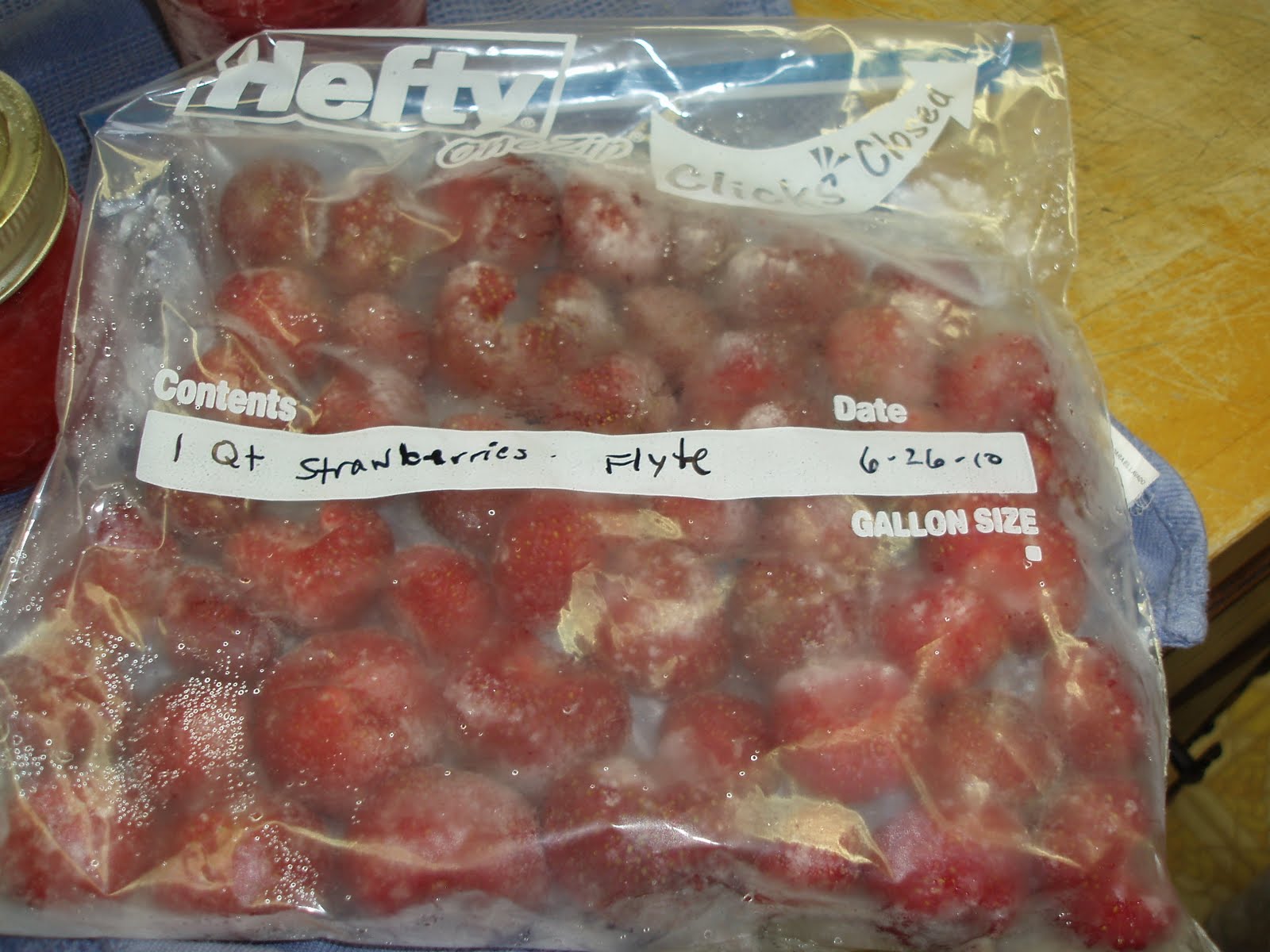
Here's what's competing for space in the yet-unpurchased freezer so far:


Strawberry jam (this is actually my last jar from last year's six batches - this year's jam is still at my parents' house, along with the top layer of my wedding cake, which Michael is still intending to eat on our anniversary), whole strawberries, mashed strawberries with a little sugar (I bought eight quarts of berries from a farm stand in town after we got back from our honeymoon- my mom couldn't believe they still had berries on the 26th), peas, peas, and more peas. Not shown: two pounds of asparagus and big plans for the rest of the summer!