Showing posts with label recipes. Show all posts

Sunday, September 19, 2010

Too Many Veggies!

Between my bad habit of taking too much cash to the farmers' market, my garden, and my CSA membership, I have too many vegetables in my kitchen!

While I was able to turn large batches of peas, green beans, tomatoes, corn, zucchini, pumpkin, and apples into food for later in the year, I was blessed with four bags of red potatoes from my CSA, along with the warning, "These are not storage potatoes, so you should eat them up." Eat them with what?? I throw other vegetables into soups and freeze them for later. But potatoes don't freeze well. And I couldn't seem to get my act together to coordinate the thawing of some kind of meat with other veggies and the potatoes to make very many meals.

Maybe part of this is due to the fact that I now have two part-time jobs, neither of which has a set schedule, so I can't always count on a regular time to cook anymore. (Case in point: I had to work this past Thursday, which had been a day off for several weeks, thus, I did not cook anything or write multiple posts that day.)

Part of it might also be that, as much as I love fall and the romantic notion of "harvest" associated with my upcoming (but still two months away) favorite holiday, the joy of an overwhelming abundance of fresh produce has worn off. The potatoes have the misfortune of ripening after thrill of the harvest has worn out its welcome.

This morning, however, I was able to clear six bags of produce out of my kitchen! I used two brown bags of CSA potatoes, two bags of carrots (one from the CSA, one from my garden), a bag of yellow beans and a bag of green beans - both from the CSA. I also used two onions (one from the CSA, one from a farm stand) and leftover cloves of two types of garlic from the CSA and the Farmers' Market. This is my first all-local shepherd's pie. (And it's not really shepherd's pie because it is made with local, organic beef, not lamb. It is technically a cottage pie, but I grew up calling it shepherd's pie and I'm going to stick with that, in spite of the fact that this dish doesn't really resemble my mom's at all.)

I actually made two dishes - one large casserole dish for my house, and a smaller one for my parents. (My mom's shepherd's pie consists of one pound lean ground chuck, browned and drained, one can cream of mushroom soup, one-third of a soup can of water, one or two cans of green beans, and about 8 servings of Hungry Jack mashed potatoes. It was one of my favorite dishes growing up. The first time I cooked it for my husband I said, "I don't care if you like this or not. It's my favorite dish, and I'd appreciate it if you keep any negative comments to yourself." (For the record, he has never complained about my cooking. And this is now one of his favorite meals too.) In the past, I tried to cram too many vegetables into my large casserole dish for shepherd's pie, and, as happens too often in my kitchen, I had some overflow problems.

I used one pound of ground beef. I did not drain the beef because it is really, really low fat. I used what little drippings there were to cook my onions. You might choose to use more meat, but I spent many years as a vegetarian and I like the thought of meat as a condiment instead of a main dish. (To replace the canned cream of mushroom soup that would normally be mixed in with the beef, I could have made my own cream of mushroom soup from chicken stock, mushrooms, and cream. But there was no way I was going to buy MORE produce for this dish. The point was to get rid of all the veggies I hadn't been eating!)
I added fully cooked green and yellow beans. I'm not sure how many - but it was two weeks' worth from our CSA.
I also added fully cooked carrots. In the past, I made the mistake of adding lightly steamed veggies to the pie, thinking they would cook more as the dish baked. They didn't. And I did not appreciate crunchy parsnips and carrots in my comfort food.
I topped the dish with a layer of garlic mashed potatoes.
I put the casseroles in my fridge, and will cook one for dinner tomorrow night.

(I could have added corn and peas from my freezer, but I wanted to keep it simple. This dish had plenty of good stuff in it, and I might really want the corn in March.)

Then I went to my garden and dug up several more potatoes, a large bunch of carrots, and picked a huge zucchini and over a dozen tomatoes. I traded my dad the small shepherd's pie for a hunk of stuffed zucchini. I also picked three butternut squash, one of which I will use to make soup later in the fall. I left it at my parents' house for safekeeping.

I still have three bags of beets in the fridge (two from the CSA, one from the garden)(I like beets - but I have a mixture of golden beets and red ones and can't decide if I should cook them all together or separately), another bag of green beans, several small peppers, a bag of tomatillos, a bag of mixed lettuce, two baggies of radishes, and a bunch of cilantro.

I will be making salsa soon. And beets.

Wednesday, September 15, 2010

Beverage of Choice

In college, my roommate and I bought Mountain Dew by the case - and we could easily go through two cases in a week. (Her mother subsidized this addiction.) We built a shrine out of Mountain Dew cans to a quarterback (who shall remain nameless) whose face happened to be plastered on the cans because he was headed to the Superbowl, and at the time his uniform was a good match for Mountain Dew's logo.

I have not kept pop in my house since after I took the Bar Exam, except for maybe a random purchase here and there, but I have a weakness for ordering pop at restaurants. (Except last summer when I was making an effort to drink 9 glasses of water ever day, and I didn't have any room left over for soda!) In addition to drinking a lot of water last summer, I started reading about local foods and real foods, and obviously, soda didn't make it on my shopping list. But lately, in spite of my continuing interest in local, real foods, I have been craving soda. Especially Mountain Dew. My boss is not a coffee person, but her love of Mountain Dew seems to be contagious.
I'd like to say that this is just a prop, or an old photo from college, but it isn't. After looking at every liquid substance in my house this evening, and discovering (not at all to my surprise) that none of them were Mountain Dew, I headed to the grocery store with a short list - I wanted a 20 ounce bottle of soda for right now, and the ingredients to make homemade ginger ale tonight.

I read this post on Table of Promise and was excited to see a very simple home-made replacement for soda. (COB is more hard-core than me when it comes to high-fructose corn syrup.) I checked out the original recipe, and headed to the store for ginger and seltzer water. (I've never bought raw ginger root before.)

I used a cup and a half of turbinado sugar instead of honey like COB or (presumably) pure cane sugar like the original.
I did this for two reasons. First, turbinado sugar is less processed than white sugar. As the packaging from the sugar I bought today explains, "Turbinado Sugar is the natural alternative to white sugar. It is harvested from 100% sugar cane. But unlike white sugar . . . Turbinado Sugar is what remains after raw sugar is washed. Once the impurities in raw sugar have been washed away, turbinado sugar remains, with a natural coating of sweet golden molasses." (And I always believe everything corporate food processors tell me. Stay tuned for more on this topic . . .) Second, I have always wanted to buy a bag of this sugar, but 24 ounces sell for $5, and I've never had such a good excuse to spend money on this unnecessary item before. (Also, while I could have used local honey like COB, the fact that my ginger came from Thailand sort of makes the origin of the sweetener a moot point. And since I don't even know if I'm going to like the finished product, I didn't want to waste perfectly wonderful honey.)

I mixed the sugar with a cup of water, and a little over a cup of raw, peeled, chopped ginger.
I brought it to a boil, and now it is steeping. I will leave it in the fridge overnight.
I will post pictures of the finished product when we drink it.

Friday, August 20, 2010

Oh yeah, a recipe

Sorry folks, it's been a crazy week. And I know there are hundreds of avid blog readers out there, incessantly hitting the "refresh" button at the top of your screen, waiting, salivatingly, for my tomato puree recipe to pop up as a new blog. (Hey, a girl can dream . . . )

Drumroll please . . .

Tomato Puree, My Way (with pictures - Yes, I am recycling pictures. No, I did not have time to make another batch of tomato sauce this week):

1. Boil water in a largish pot (not a stock pot, but something you'd use to make a decent sized batch of spaghetti noodles).

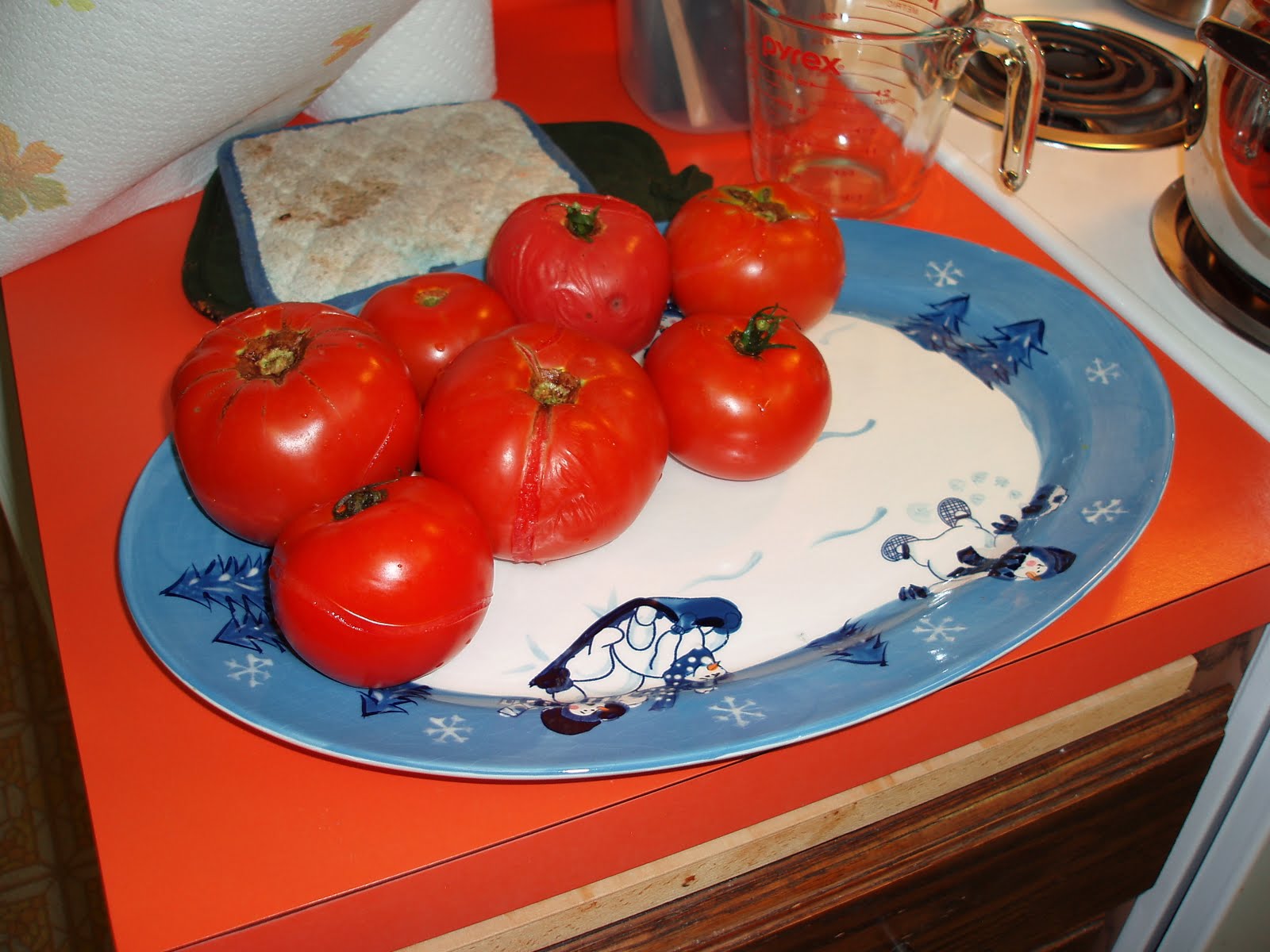
2. Blanch tomatoes, four or five at a time, until their skins crack.

3. Remove the cracked tomatos and set them on a plate or your favorite snowman platter.
4. If a tomato hangs out in the water for a long time and does not crack (like my tiny tomatoes, and the romas I used from our CSA share - not pictured above) go ahead and pull it out.

5. Peel the skins off and core the tomatoes. This should be easy. It goes faster if one person blanches tomatoes while another skins them. Be careful - they might be hot. (Some people dip the tomatoes in ice water first. My mom never did that step, so neither did I. It is faster and the tomatoes don't get waterlogged, but you do have to watch your fingers. Especially if you're planning keep them in good shape so you can dunk them into a pan of scalding water in a few hours.) (By the way, after a rough night where it literally felt like both hands were on fire, I woke up in the morning and my hands were fine. I went to work and helped small children make hide paintings My feet, on the other hand . . .)

6. Cut the skinned tomatoes into chunks and put them into a really big bowl, cutting off any bad parts first. (When I did this part alone, in the morning, with the first 15 lbs of tomatoes, I seeded the tomatoes and squeezed the juice out, according to a recipe I found online. I discovered with my chinois set that this was an entirely unnecessary step, and wasted time and good tomato pulp - especially from the romas.)

7. Grab a handful of tomato chunks, stick them in the bottom of the chinois set (wikipedia spells it chinoise, listing chinois as an alternate spelling, but I'm going with what was on my otherwise-utterly-unhelpful packaging), and move the wooden cone (kind of like a mortar and pestle, but with a sieve instead of a solid bowl on the bottom) around in a circular motion. I used the chinois set over a large glass cake pan the second time around, because it held more, and I didn't want to scratch my stainless steel pot. Not that I wanted to scratch the cake pan . . . surely someone out there has a better suggestion.) I thought this would be difficult. Since the chinois set came with literally no instructions (not even washing instructions) I was not sure what would happen when I put the tomatoes in. The holes looked larger than tomato seeds - I thought the seeds would fall right through. I tried a tiny amount of tomatoes (which didn't really have that many seeds anyway because I seeded the first batch) and put them in, mashing them around with the wooden cone. I didn't know what to expect, but was delighted to see a little puddle of what really looked like tomato paste under the contraption. I'd been prepared to take the chinois set back to the store (you can see the plastic bags that the pieces had been wrapped in in the background) if it didn't give me the results I wanted. I'd read one recipe that called for making puree in a blender, so I had a back-up plan. But I gave the chinois set a try, and was very pleasantly surprised. The chinois set worked, and I didn't have to use any electricity to get the puree. Very cool. (Getting off the grid is going to become my next big obsession, after I've fully conquered home canning and locovorism. Just so you know. But I digress.)

8. Continue this until your pasty puddle of tomato below the chinois set is overflowing, and pour it into one of several containers you have sitting out for this purpose. (Assuming you're going for the full 10 quarts.)
9. Load up the chinois set for another round of smashing.
10. Use your tomato puree to make tomato sauce.

11. Have some of your family over for dinner to sample the tomato sauce, to thank your dad for his help, and to show off a little. Make homemade garlic croutons from homemade bread to serve with your sister's homemade raspberry vinaigrette. Use your dad's garden flowers as a centerpiece. Take a walk by the river. Actually feel chilly for the first time all summer. Forget to take a picture. Oh wait, skip that last one!
Thanks dad! I'm glad I get to grow stuff and cook stuff with you. Next time we'll have to remember to eat off of our own pottery! (And take pictures of the meal.)

Friday, August 13, 2010

Canning up a storm!

Okay, one batch of tomato sauce is not really a "storm," but it has been storming outside all day long. In fact, when I went to the grocery store to pick up a few last-minute ingredients this morning, I encountered three roads that were too flooded to travel. (I only live about 2.5 miles from the grocery store - we've had some serious flooding issues this summer.)
I'm not sure if you can see the raindrops on the window, but it was absolutely storming outside. The light between the trees is actually a reflection of our living room lamp.

Blanched tomatoes. (I also use this snowman platter for cutting sweet corn off the cob to freeze. I use it because it has the best shape of all of my dishes for that job, but it is also a good reminder about how all this hard work will pay off in the middle of winter.)

Making tomato puree with the Chinois set I got last week, which - to my dismay - came with no instructions. (I love it. I'm not sure if I used it correctly, but I like what it did.) My hair got more frizzy and my face got redder as the day went on, if you were wondering ;)

Tomato puree, my way. (And the tomatoes that weren't cut out for canning. They ended up in our dinner - caprese salad, of course - and the salsa I made while the sauce was simmering.)

When my dad and his dog Gizmo arrived, they jumped right in the mix. My dad cleaned the tomatoes he brought, then while I blanched them he chopped the four onions he brought - three of which came from our garden!
I think he had a good time. In addition to chopping onions, he read all the directions about the water bath, and how to prepare the jars, and he did the bulk of the dishwashing, too!
Ten quarts of tomato puree is a lot!

The dogs liked to lay on the floor between the stove and the island where I was doing most of the prep. Amazingly, we didn't drop anything on either dog.

Confession: I didn't really have a recipe to make the tomato puree that my tomato sauce recipe called for. I had to kind of wing it based on other recipes and some advice from my mom. (I will post my very own personal recipe soon.) The actual tomato sauce recipe (from Animal, Vegetable, Miracle) started with: "soften the onions in a heavy 3-gallon kettle."

And we're off!
While the onions softened, I mixed the rest of the spices, then added them, along with most of the tomato puree. (Our pot wasn't quite big enough. I simmered the rest separately and added it when there was room in the pot.)
Eventually it started to cook down. (That is a piece of my homemade dried basil floating in the top. I didn't crush the leaves very well before throwing them in the pot.)

While the sauce simmered my dad washed 7 quart jars.
The 21.5 quart water bath doesn't quite fit back there, but we made it work.

This is after I had poured all of the sauce into the pot. I let it simmer down for about another hour because Michael was at a movie with a friend and my dad had gone to have dinner with his brother. I was too freaked out about botulism to actually do the canning on my own.

I would write more about the process, but I managed to scald my right thumb and index finger, and most of my left hand while putting the lids on the jars. (That's right, I plunged my left hand right into a pot of almost-boiling water.) Other than that minor incident, and my mini freak-out when Michael and my dad were both gone, the canning went surprisingly well. Especially since I made my first foray into canning on Friday the 13th!

Busy kitchen: bread in the oven, sauce on the stove, salsa in the making.

Local salsa. The tomatoes are from my garden, the CSA, and leftover canners that had blemishes. The onions, peppers, cilantro, and garlic are from the CSA. (The chips are from the grocery store, but I never said I was perfect.) I dealt with my stress over the possibility of having to can alone by chopping. If my dad hadn't returned by the time the salsa was done, I would have done the next best thing - dishes.

The Finished Product(s)

My dad brought me a zucchini with the tomatoes. Before I could put the new zucchini in the fridge I had to do something with one that was already in there. It became zucchini bread. (Slightly underdone zucchini bread because I forgot to set the timer.)

Salsa (which I haven't tried, but Michael says is good).

Seven jars of canned tomato sauce - my first batch of canned goods. (The 8th jar did not fit in my water bath and will be stored in the fridge till we eat it next week.)

Maybe when my fingers feel better I will do the math and figure out a cost comparison between home-made and grocery store tomato sauce. I wonder how much our labor worth . . . it took me 11 hours, mostly on my feet in the hot kitchen, and I couldn't have done it at all without my dad's help!

Tuesday, August 10, 2010

Catching Up

Karen and Anna Kate at Circus World Museum.

Since I wrote my last post, I got a new very part-time, seasonal job as an interpretive guide at a local museum here in town. I also went to Indiana to visit Uncle Fred and see some darling little girls. And I have spent some quality time in the garden and kitchen, of course.

My dad and I planted fall crops of beets, beans, carrots, peas, and some lettuce, which I think I already posted. The beets and beans are definitely growing. I'm not sure where my dad planted the lettuce - that's his domain. I will check on the garden later this week and hopefully I will see some carrot and pea sprouts. I'm afraid it might be too hot for them, with temperatures in the high 80s and a heat index close to 100!

While I'm waiting for the new seeds to grow, I have still been hauling in zucchini and cucumbers, and the tomatoes are getting serious about producing too. I'm not sure whether I posted that we harvested the onions or not. They are drying on an old screen window in the garage. We pulled about 60 of them. I had already eaten about 10. Next summer I hope to plant more. 60 onions won't get us very far. I have already had to buy onions at farmers' markets a few times this summer. (Back before I read Animal, Vegetable, Miracle, I liked to keep a couple of bags of frozen diced onions on hand because, like garlic, it is often hard for me to get by in the kitchen without them.) I still need to find a place in my house to store onions for the winter.

On Monday at work, the groundskeeper at the museum told me his wife was canning green beans. We swapped zucchini bread recipes, and talked about pickles. We had gotten a jar of pickles from some friends the previous Wednesday. They are refrigerator pickles, no cooking or canning required, and our friends had forwarded me the recipe. I had several pounds of cucumbers i my fridge and I finally worked up the courage to make pickles. I went to the store for jars after realizing I did not have enough containers in my house for all of my soon-to-be pickles. I also needed pickling salt and a few spices.

I ended up making 3 pints of sweet pickles (sorry I did not take a picture) and 6 pints of dill pickles. On the advice of our friends, I did not add as many hot pepper flakes to my dill pickles as the recipe called for. I also skimped on the dill seed in two of the jars, because I was running low. The sweet pickles were ready after 2 days, but the dill pickles had to be shaken once a day for a week before they were ready. I am planning to make another batch of both types of pickles soon, although we much prefer the sweet pickles. I am going to experiment with the dill recipe, maybe combining some other recipes I find online.
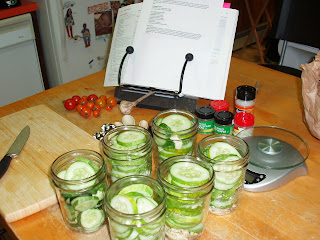
jars of cucumbers waiting for brine.

That night I also sauteed a huge zucchini for our dinner, served with caprese salad. I also made two loaves of zucchini bread. Instead of using my fancy recipe with yogurt and a lot of ingredients, I went with Betty Crocker. I'm not sure why the recipe calls for oil instead of butter, and I might have to experiment with that next time, but the bread was very good and much simpler to make, and calls for either white or whole wheat flour, instead of a blend of both.
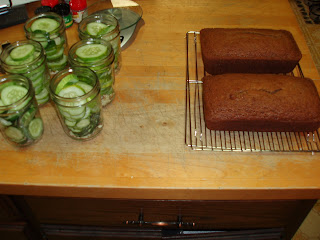
Busy countertop.

Last week I also took a friend to the farmers' market. She lives conveniently right down the street from a market that is open on Wednesdays and Saturdays, which is very handy! But she hadn't been to the farmers' market in years, and was understandably a little bit overwhelmed with the new type of shopping experience. She came prepared with cash and reusable bags, but shopping at the farmers' market can be very different from shopping at the grocery store. For instance, a vendor may advertise tomatoes for $2.00 a pound - but how does one know how much a pound of tomatoes is? At the grocery store, there are hanging scales that customers can use themselves to weigh produce. But at a stall at the farmers' market, sometimes the scale is behind the table, and only the vendor can reach it. Maybe you see three really nice-looking tomatoes, but are unsure of how much they weigh. Do you pick them up and hand them to the vendor to be weighed, and then gasp in shock and horror when you are told that your three plump, rosy tomatoes will be $9.00? At that point, do you hand over the money, or retract your offer? When vendors have green beans separated into little plastic baskets and the vendor asks whether you want a bag, should you be green and suggest the vendor just pour the whole basket into your reusable nylon bag, or should you let the vendor put the beans in a plastic bag so that they are protected from the rest of your produce? Do you pick your own leeks or do you let the vendor choose? (At this particular market, one farmer's wife loves to pick sweet corn for her customers. She also shucks it for no additional charge. Other vendors are more inclined to let you choose your own and shuck it at home.)

Fortunately, as I was able to remind my friend, the vendors are people too. I think they know that not every customer is well-versed in shopping at the farmers' market, and they are there to help! If you don't know how many mini cucumbers make up half a pound (the amount you've chosen because it is what you want to spend), just ask. I think most vendors will be happy to either give you a verbal estimate, or to actually put the produce on the scale. And if you're waffling about a purchase because you really don't know how to tell whether a melon is ripe, the vendor might give you a taste!

We had a very good day at the market, except that I got so excited about buying a cantaloupe that I forgot to pick up an eggplant, and had to make ratatouille with 2 lbs of zucchini and summer squash instead of one pound of zucchini and one pound of eggplant. It still tasted really good. (Sorry, no pictures.)

Partial haul from Wednesday. Corn, tomatoes, zucchini and cucumbers (not pictured) from the garden. Cantaloupe and onions from the farmer's market. The cucumbers and yellow squash in the background are from our CSA.

I had a busy night in the kitchen on Wednesday night. After visiting the farmers' market and working in the garden for a few hours (and freezing tomato sauce with my mom!) I picked up our CSA share and got right to work. I missed my book club, which was okay because I hadn't read the book. (The Book Thief by Marcus Zusak. I noticed that one of the bloggers I read lists this as the book she is currently reading.) I couldn't get into the book after about the first 6 pages, and loaned it to my sister. (I read the first page aloud to her, exasperatedly wondered how anyone could read this, and was shocked to hear her say it sounded interesting. Later, I told my neighbor about this book I couldn't get into. She asked what it was. I told her. She called to her husband, "Katie says she doesn't like Elizabeth's friend's book. Can you believe it?" "Elizabeth" would be Elizabeth Eulberg, my neighbor's daughter, the publicist for the Twilight Saga, and author of The Lonely Hearts Club. Apparently Markus Zusak is a personal friend. Maybe I'll try to read it again when I get it back from my sister.)


Instead of hanging out in a book store, having good conversations with interesting people, I hung out in the kitchen alone, and made salsa. I had never made salsa before,* but we got fresh cilantro from the CSA and I had plenty of tomatoes, so it seemed like a logical thing to make. (I can't really remember what we had for dinner, but it was probably zucchini sauteed in olive oil with a clove or two of garlic thrown in at the end, seasoned with a little salt and fresh cracked pepper. I top mine with feta cheese and my sweetie puts shredded farmer's cheese on his.) I love salsa with mango in it, but have no access to mangoes, so I improvised with part of my cantaloupe instead. I diced some melon, chopped a bunch of cilantro, threw in the raw corn from my garden (which my parents said is not that great on its own, but it worked very well in the salsa), and a few squirts of lemon juice. I also added green onions from our CSA, and a few dashes of black and white pepper. I did not have any hot peppers in the house, but thought the salsa needed a little zing.

* In hindsight, I realized that this is not strictly true. I made salsa once in 7th or 8th grade at school in Spanish class. Senorita Speaks gave us the recipe and I tried it at home with my mom. I don't recall any of the ingredients. I do remember that it was a LOT of work, and I think it made several gallons of salsa, of which we ate maybe a couple of chip-fulls each.
We didn't have any tortilla chips in the house, but quickly remedied that on Thursday, and the salsa disappeared over the weekend.

In addition to bringing home lots of fresh produce on Wednesday, I also bought a water bath canner, a jar lifter, and other various canning supplies. I've been waffling back and forth about whether or not to can tomato sauce, or just freeze it this summer. Honestly, I'm a little bit scared of canning, which is strange because I grew up eating my grandma's canned pears and maybe peaches, canned jelly, pickled beets, bread and butter pickles, and lots and lots of canned tomato sauce, which, as my mother likes to say, has never killed anybody yet. Watching experienced grown-ups can, and contemplating actually doing it myself are two entirely different things. I read about people canning. I just found a new blog where a homeschooling mother of four cans a lot of different vegetables (and salsas). She makes it sound so easy. Her 10 year old son did some canning for a project for 4H at the county fair. Then I read things like, "old cookbooks are really neat to look at but don't you dare use the canning recipes in them because those people didn't know what they were doing, and didn't know what botulism was" which concerns me because the recipe in my kitchen for pickled beets (which my dad used last summer with great results) is from my grandmother. Heaven only knows who or where she got it from. Barbara Kingsolver gives a great-sounding recipe for tomato sauce in Animal, Vegetable, Miracle, which calls for a cup of dried basil. I would like to replace this with fresh basil, but she warns against changing any ingredients or adding fresh herbs/spices because you might change the pH of the sauce, and render it deadly. The homeschooling lady offers a tomato puree recipe and breezily advises the home canner to, "throw in a couple of fresh basil leaves for added flavor." Yikes. (It is safe to assume the homeschooling lady has not killed anyone yet either, right? - I will try to add her to my list of blogs I read soon) (One reassuring thing is that this homeschooling lady uses the Ball Blue Book of Preserving, which my mom bought for my dad and me earlier this summer.)

In spite of my trepidation, I have put in an order for tomatoes at my local farmer's market. Kingsolver's recipe calls for about 30 lbs of tomatoes to make into 6 or 7 quarts of tomato sauce, and I think I'm really going to do it. I'll keep you posted.

Later this week, after I pick up more vinegar and dill seed, I will be making more pickles. And probably a loaf of zucchini bread or two.

Monday, July 19, 2010

Bread

I love banana bread. I found a recipe for banana bread in the newspaper approximately 15 years ago, and it became my signature baked good. (Along with berry pies that I used to show off for my uncles.) But after I read Animal, Vegetable, Miracle by Barbara Kingsolver, I couldn't buy bananas anymore. I miss them. I miss baking banana bread. I was sort of intrigued by the sneaky zucchini-chocolate chip cookie recipe in Miracle, and my dad had made zucchini bread a few times when I was a kid (although I might be the only person to remember that), so I tried a zucchini muffin recipe last summer. It was good. I experimented with it. I recently posted it on my blog. But I wasn't attached to it, you know? The copyrighted zucchini bread I made last week was good, but it was too sweet. It wasn't my recipe. There was no batter-spattered recipe card in my stack called "Katie's Zucchini Bread" in alphabetical order behind "Jenny's Pumpkin Bread" and "Katie's Banana Bread." My sister had never called asking for the recipe. Twice.

Tonight, I played around and tweaked a little bit, and I think I may have hit upon Katie's Zucchini Bread. It's a good thing I'm not finished typing up all of my recipes yet, because I have another one for my collection. I think I can be attached to this one. In fact, I think I'll shred some zucchini on Thursday afternoon to put in my new freezer, so it can be all ready to pull out in January when I need a little taste of summer. (Also, it will be nice to clear up some space in my fridge for the rest of July.)

Katie's Zucchini Bread

1 3-lb zucchini
2 cups all-purpose flour
2 cups whole-wheat flour
2 1/2 teaspoons baking soda
2 teaspoons baking powder
1 teaspoon salt
2 teaspoons cinnamon
2 teaspoons allspice
1 cup sugar
1 cup honey
1 1/2 sticks of unsalted butter, melted and cooled
4 eggs
1/4 cup yogurt

Makes 2 8-1/2 by 4-1/2-inch loaf pans.

Adjust an oven rack to the middle position and heat the oven to 325 degrees.

Cut zucchini in half lengthwise and remove seeds with spoon. Shred zucchini. Place shredded zucchini in a towel, and squeeze out the water. (This will remove approximately half a pound of water.)

Whisk together the dry ingredients and set aside.

Combine the sugar, melted butter, honey, eggs, and yogurt together in a large bowl. Slowly add the dry ingredients. (I do this by hand.)

Pour the batter into a greased pan (you could also flour the pan, but it is probably not necessary) and bake for about one hour and ten minutes.
Yeah, I know, my oven's not clean. I spilled zucchini bread in it last week, remember?

The honey (which I included because it is local) makes the bread turn brown early in the baking process. Don't be fooled. Insert a toothpick or a knife into the center of the bread to test doneness. If it comes out soggy, put the bread back in the oven. If just a few crumbs are attached, take the bread out of the oven, let it cool for a while (10 minutes?) and turn it out onto a wire rack. I'd eat it as soon as it's cool enough to handle.


My husband approves this recipe :)