Showing posts with label gardening. Show all posts

Thursday, October 14, 2010

Last of the Zucchini, Take Two

On Wednesday, before I picked up the last CSA of the season, I went to my parents' house. I went there for two reasons. First, I wanted to see my dad who had knee surgery last week, but is now up and walking around on crutches. Second, I wanted to do some gardening.

I left the remaining carrots in the ground, since they keep well there, and knew I was getting some from the CSA. I picked a lot of zucchini, though. And two potatoes, two butternut squash, and a pumpkin. And I brought some questionable onions home with me.

I'm not kidding about the zucchini. I picked a Lot. NINE.
The dog ate part of one, because the flower end was starting to rot.

Okay, so they weren't particularly large zucchini, like some of the ones I harvested this summer. In fact, they were downright puny:
but they're still zucchini (and that is a votive candle).

I made the rest for dinner tonight, along with an eggplant I picked up at my local Thursday Farmers' Market,
two CSA onions and one questionable onion from my garden, (The onions my dad and I grew are all spotty and slightly soft.)
a quart of homemade tomato puree from Thursday Market tomatoes,
and some garlic powder, because I don't have any real garlic at the moment.
Okay, okay, I also threw in the 16 ounce package of button mushrooms from California that I bought at the grocery store last week.
I mixed this veggie goodness with a package of curly pasta that my husband requested from the grocery store. Voila. Dinner for two, and a whole lot of leftovers.

Thursday, September 9, 2010

New Squash Season

While I picked plenty of zucchini in the garden yesterday, some other squash varieties were clamoring for attention.
Bright orange ones!

The butternut squash are not quite ready yet, but the pumpkin vines have been crumbling off of the pumpkins for a few days, so it seemed to be time to harvest the pumpkins.

My dad took a couple to Indiana for the grandkids, and I brought 7 home to turn into puree.
I chopped and shredded the zucchini while four of my pumpkins were roasting in the oven.

After I roasted them, I turned them into puree, and saved the seeds for a crispy snack.

I learned last fall that the easiest way to cook a pumpkin is to put the whole thing in a 350 degree oven (in a pan) with a few slits in the top to let the steam out. It doesn't work if you need chunks of pumpkin, but if you need puree for soup, bread, cookies, pie, etc., you can't beat this method.
I fit four pumpkins in the oven at once and cooked them for a little over an hour.
It's amazing how much easier a pumpkin is to carve after it is cooked!
The flesh comes right off of the skin with a small spoon and gentle pressure.
I used a hand blender to turn the stringy chunks into puree:
and then I got to work on the seeds.


I seasoned them with garlic powder, onion powder, seasoned salt, and pepper, then roasted the seeds at 350 until they popped. I was chopping apples and not paying attention to time, but my recipe, from Elspeth's blog, said that they would pop - and they did.In the meantime, I had picked up a bushel of apples at the farmers' market, and was working on a batch of apple butter. Since I was already looking for containers and measuring out large amounts of sugar and fall seasonings, I decided to make some pumpkin butter with my pumpkin puree.
Four cups of puree, plus four cups (!) of brown sugar, 5/8 tsp cinnamon, 1/4 tsp each of nutmeg, allspice, and ground cloves, and a couple of squirts of RealLemon juice. (The recipe called for the juice of two lemons, but I used the lemon juice I have on hand for canning.) I wanted to use some of my beautiful maple syrup, or at least some honey as sweetener, instead of all of the sugar, but I've never even eaten pumpkin butter before, and decided not to mess with the recipe until I knew what I was getting myself into. (I made half a batch, which made about 6 cups after simmering on low for an hour - while I made pesto.)

I'm not sure whether I like pumpkin butter or not. We don't have any bread in the house to eat with the pumpkin butter . . . because I'm having a little difficulty with the bread machine I'm borrowing from my parents. (I can't get it apart to wash it. I tried soaking it overnight. Twice.)
But it was a productive day, and I still have three whole pumpkins and about 4 cups of puree in the fridge. And since Jenna posted this recipe, I have an idea of what to do with it!

Tuesday, August 10, 2010

Catching Up

Karen and Anna Kate at Circus World Museum.

Since I wrote my last post, I got a new very part-time, seasonal job as an interpretive guide at a local museum here in town. I also went to Indiana to visit Uncle Fred and see some darling little girls. And I have spent some quality time in the garden and kitchen, of course.

My dad and I planted fall crops of beets, beans, carrots, peas, and some lettuce, which I think I already posted. The beets and beans are definitely growing. I'm not sure where my dad planted the lettuce - that's his domain. I will check on the garden later this week and hopefully I will see some carrot and pea sprouts. I'm afraid it might be too hot for them, with temperatures in the high 80s and a heat index close to 100!

While I'm waiting for the new seeds to grow, I have still been hauling in zucchini and cucumbers, and the tomatoes are getting serious about producing too. I'm not sure whether I posted that we harvested the onions or not. They are drying on an old screen window in the garage. We pulled about 60 of them. I had already eaten about 10. Next summer I hope to plant more. 60 onions won't get us very far. I have already had to buy onions at farmers' markets a few times this summer. (Back before I read Animal, Vegetable, Miracle, I liked to keep a couple of bags of frozen diced onions on hand because, like garlic, it is often hard for me to get by in the kitchen without them.) I still need to find a place in my house to store onions for the winter.

On Monday at work, the groundskeeper at the museum told me his wife was canning green beans. We swapped zucchini bread recipes, and talked about pickles. We had gotten a jar of pickles from some friends the previous Wednesday. They are refrigerator pickles, no cooking or canning required, and our friends had forwarded me the recipe. I had several pounds of cucumbers i my fridge and I finally worked up the courage to make pickles. I went to the store for jars after realizing I did not have enough containers in my house for all of my soon-to-be pickles. I also needed pickling salt and a few spices.

I ended up making 3 pints of sweet pickles (sorry I did not take a picture) and 6 pints of dill pickles. On the advice of our friends, I did not add as many hot pepper flakes to my dill pickles as the recipe called for. I also skimped on the dill seed in two of the jars, because I was running low. The sweet pickles were ready after 2 days, but the dill pickles had to be shaken once a day for a week before they were ready. I am planning to make another batch of both types of pickles soon, although we much prefer the sweet pickles. I am going to experiment with the dill recipe, maybe combining some other recipes I find online.
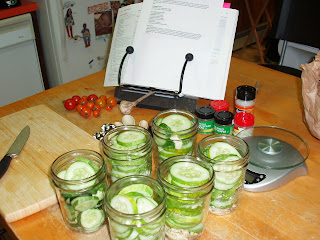
jars of cucumbers waiting for brine.

That night I also sauteed a huge zucchini for our dinner, served with caprese salad. I also made two loaves of zucchini bread. Instead of using my fancy recipe with yogurt and a lot of ingredients, I went with Betty Crocker. I'm not sure why the recipe calls for oil instead of butter, and I might have to experiment with that next time, but the bread was very good and much simpler to make, and calls for either white or whole wheat flour, instead of a blend of both.
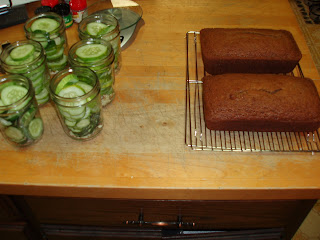
Busy countertop.

Last week I also took a friend to the farmers' market. She lives conveniently right down the street from a market that is open on Wednesdays and Saturdays, which is very handy! But she hadn't been to the farmers' market in years, and was understandably a little bit overwhelmed with the new type of shopping experience. She came prepared with cash and reusable bags, but shopping at the farmers' market can be very different from shopping at the grocery store. For instance, a vendor may advertise tomatoes for $2.00 a pound - but how does one know how much a pound of tomatoes is? At the grocery store, there are hanging scales that customers can use themselves to weigh produce. But at a stall at the farmers' market, sometimes the scale is behind the table, and only the vendor can reach it. Maybe you see three really nice-looking tomatoes, but are unsure of how much they weigh. Do you pick them up and hand them to the vendor to be weighed, and then gasp in shock and horror when you are told that your three plump, rosy tomatoes will be $9.00? At that point, do you hand over the money, or retract your offer? When vendors have green beans separated into little plastic baskets and the vendor asks whether you want a bag, should you be green and suggest the vendor just pour the whole basket into your reusable nylon bag, or should you let the vendor put the beans in a plastic bag so that they are protected from the rest of your produce? Do you pick your own leeks or do you let the vendor choose? (At this particular market, one farmer's wife loves to pick sweet corn for her customers. She also shucks it for no additional charge. Other vendors are more inclined to let you choose your own and shuck it at home.)

Fortunately, as I was able to remind my friend, the vendors are people too. I think they know that not every customer is well-versed in shopping at the farmers' market, and they are there to help! If you don't know how many mini cucumbers make up half a pound (the amount you've chosen because it is what you want to spend), just ask. I think most vendors will be happy to either give you a verbal estimate, or to actually put the produce on the scale. And if you're waffling about a purchase because you really don't know how to tell whether a melon is ripe, the vendor might give you a taste!

We had a very good day at the market, except that I got so excited about buying a cantaloupe that I forgot to pick up an eggplant, and had to make ratatouille with 2 lbs of zucchini and summer squash instead of one pound of zucchini and one pound of eggplant. It still tasted really good. (Sorry, no pictures.)

Partial haul from Wednesday. Corn, tomatoes, zucchini and cucumbers (not pictured) from the garden. Cantaloupe and onions from the farmer's market. The cucumbers and yellow squash in the background are from our CSA.

I had a busy night in the kitchen on Wednesday night. After visiting the farmers' market and working in the garden for a few hours (and freezing tomato sauce with my mom!) I picked up our CSA share and got right to work. I missed my book club, which was okay because I hadn't read the book. (The Book Thief by Marcus Zusak. I noticed that one of the bloggers I read lists this as the book she is currently reading.) I couldn't get into the book after about the first 6 pages, and loaned it to my sister. (I read the first page aloud to her, exasperatedly wondered how anyone could read this, and was shocked to hear her say it sounded interesting. Later, I told my neighbor about this book I couldn't get into. She asked what it was. I told her. She called to her husband, "Katie says she doesn't like Elizabeth's friend's book. Can you believe it?" "Elizabeth" would be Elizabeth Eulberg, my neighbor's daughter, the publicist for the Twilight Saga, and author of The Lonely Hearts Club. Apparently Markus Zusak is a personal friend. Maybe I'll try to read it again when I get it back from my sister.)


Instead of hanging out in a book store, having good conversations with interesting people, I hung out in the kitchen alone, and made salsa. I had never made salsa before,* but we got fresh cilantro from the CSA and I had plenty of tomatoes, so it seemed like a logical thing to make. (I can't really remember what we had for dinner, but it was probably zucchini sauteed in olive oil with a clove or two of garlic thrown in at the end, seasoned with a little salt and fresh cracked pepper. I top mine with feta cheese and my sweetie puts shredded farmer's cheese on his.) I love salsa with mango in it, but have no access to mangoes, so I improvised with part of my cantaloupe instead. I diced some melon, chopped a bunch of cilantro, threw in the raw corn from my garden (which my parents said is not that great on its own, but it worked very well in the salsa), and a few squirts of lemon juice. I also added green onions from our CSA, and a few dashes of black and white pepper. I did not have any hot peppers in the house, but thought the salsa needed a little zing.

* In hindsight, I realized that this is not strictly true. I made salsa once in 7th or 8th grade at school in Spanish class. Senorita Speaks gave us the recipe and I tried it at home with my mom. I don't recall any of the ingredients. I do remember that it was a LOT of work, and I think it made several gallons of salsa, of which we ate maybe a couple of chip-fulls each.
We didn't have any tortilla chips in the house, but quickly remedied that on Thursday, and the salsa disappeared over the weekend.

In addition to bringing home lots of fresh produce on Wednesday, I also bought a water bath canner, a jar lifter, and other various canning supplies. I've been waffling back and forth about whether or not to can tomato sauce, or just freeze it this summer. Honestly, I'm a little bit scared of canning, which is strange because I grew up eating my grandma's canned pears and maybe peaches, canned jelly, pickled beets, bread and butter pickles, and lots and lots of canned tomato sauce, which, as my mother likes to say, has never killed anybody yet. Watching experienced grown-ups can, and contemplating actually doing it myself are two entirely different things. I read about people canning. I just found a new blog where a homeschooling mother of four cans a lot of different vegetables (and salsas). She makes it sound so easy. Her 10 year old son did some canning for a project for 4H at the county fair. Then I read things like, "old cookbooks are really neat to look at but don't you dare use the canning recipes in them because those people didn't know what they were doing, and didn't know what botulism was" which concerns me because the recipe in my kitchen for pickled beets (which my dad used last summer with great results) is from my grandmother. Heaven only knows who or where she got it from. Barbara Kingsolver gives a great-sounding recipe for tomato sauce in Animal, Vegetable, Miracle, which calls for a cup of dried basil. I would like to replace this with fresh basil, but she warns against changing any ingredients or adding fresh herbs/spices because you might change the pH of the sauce, and render it deadly. The homeschooling lady offers a tomato puree recipe and breezily advises the home canner to, "throw in a couple of fresh basil leaves for added flavor." Yikes. (It is safe to assume the homeschooling lady has not killed anyone yet either, right? - I will try to add her to my list of blogs I read soon) (One reassuring thing is that this homeschooling lady uses the Ball Blue Book of Preserving, which my mom bought for my dad and me earlier this summer.)

In spite of my trepidation, I have put in an order for tomatoes at my local farmer's market. Kingsolver's recipe calls for about 30 lbs of tomatoes to make into 6 or 7 quarts of tomato sauce, and I think I'm really going to do it. I'll keep you posted.

Later this week, after I pick up more vinegar and dill seed, I will be making more pickles. And probably a loaf of zucchini bread or two.

Monday, July 19, 2010

Food I've Been Eating

I am definitely enjoying summer! Here are a few things we have been munching on.
Raspberries from the farmer's market, tomatoes, sweet corn, and blueberries from the farm stand, basil from our CSA.I think sweet corn is my all-time favorite food. Ever. Michael and my dad have volunteered to help me freeze some this summer. Maybe I'll even share some with them when the time comes ;)

Last Thursday I stopped by the farmer's market and the farm stand that sets up in late spring in the Culver's parking lot, and sticks around through early fall. (Then I went to the grocery store where I actually had to walk down aisles. I felt completely overwhelmed. I'm not kidding. I'm not used to buying things at the grocery store anymore - I didn't know where to look for things like peanuts and candy.) Michael and I thought we were going up north to visit my uncle (the farmer) in his new cabin. Our plans didn't work out, but we didn't know that they wouldn't until I'd purchased all kinds of packaged, well-traveled food for our trip. (Sausage, gatorade, M & Ms, and peanuts - did you know there are a LOT of ingredients in Planters Dry Roasted peanuts? I opted for the Emerald brand instead. They were more expensive, but only have three ingredients. Plus, my cashier found a $1.00 coupon on the top of the jar, so they were actually a better price!)

I also bought local raspberries and blueberries, along with guilty, oily cherries from the grocery store (I wish I got cherries in my CSA box!). My uncle once said I'd "make someone a good wife some day" based on the fact that I make a mean pie. (And that was before I could roll out my own crusts.)(How did he know I was going to marry a pie lover?) I thought I'd make a pie to show off the fact that I still have the knack.

We dined on sweet corn and caprese salad. Summertime, and the eatin' is easy.

Eventually it became obvious that we would not be able to go up north for the weekend. My dad was in the hospital, someone had to dog-sit for my sister, and Michael was kind of overloaded with homework. I nixed the plans to make pie. Michael and I certainly did not need huge quantities of dessert sitting around. We still had zucchini bread and muffins! So I froze three-quarters of the blueberries (I read somewhere online that blueberries do not have to be washed before they are frozen - in fact, they are better if you don't wash them. To remind myself, in December, that they are not washed, I wrote "WASH" on the bag along with the date.) I had blueberries and milk for dessert. My friend's mom taught me to eat this a long time ago. (My grandma used to eat peaches and cream, but Joyce introduced me to blueberries and cream.) Yum.

On Sunday, I baked a chicken with zucchini (from the garden and the CSA), onions (garden), and garlic (Farmers market) and served it with beets (garden and CSA), turnips (garden) and cucumber salad (with cucumbers and onions from the garden). I did not take any pictures :( But, on the positive side, we have been enjoying the leftovers!

My intention had been to buy a whole chicken, and save the carcass for soup. Unfortunately, when I went to the grocery store on Sunday afternoon (because I didn't think of it on Saturday, when I opted to skip the farmer's market, since we had plenty of produce in the fridge from our CSA, and I took home a flat of produce from my garden), they did not have the kind of chicken I was looking for. Their only whole birds were Tyson, and I would rather go vegetarian than buy a Tyson chicken, after watching Food, Inc. and reading Fast Food Nation. The grocery store sells a brand of chicken called Smart Chicken, which may or may not be a good brand. Here is a blurb from their website:

Smart Chicken® was the first poultry produced in the United States utilizing the pure air chill technology in place of water immersion. We then pioneered the utilization of Controlled Atmosphere Stunning in the U.S., ensuring that all birds are handled with care in every aspect of production. In addition, all of our birds are raised without the use of antibiotics, animal by-products or hormones. We are also Certified Organic & Certified Humane to provide you with the most premium product, produced with the highest standards, from egg to shelf.

The part that bothers me about this blurb (and I admit, the entirety of the research I did on this topic was to google "Smart chicken" and browse their website a little bit) is that it starts out with the "pure air chill technology" instead of the "Certified Organic & Certified Humane." I don't understand that, and a little more research on the website shows that Smart Chickens are fed corn and soybeans, rather than being pastured, but the company does meet the Certified Humane standard, which can be viewed in this pdf file. They are supposed to be "Free range" which means that they must "have access to the range by 4 weeks of age and for a minimum of 8 hours each day except when the natural daylight period is less." page 10. http://www.certifiedhumane.org/uploads/pdf/Standards/English/Std09.Chickens.1AD.pdf
Of course, that doesn't mean the chickens actually go outside, it just means that there are doors and a yard available . . .

Anyway . . . other than buying a fryer from an Amish farm near my home, or buying a pastured chicken at the farmer's market (which might not be possible right now, due to the fact that the spring chicks have to grow up before they will be slaughtered), right now my best option is the Smart Chicken at my grocery store. But they didn't have any. They had one packet of thighs, and possibly some boneless-skinless pieces, but no whole birds.

Row upon row of plastic-wrapped chicken with brightly colored labels showing smiling, winking chickens looked up at me from the grocery store. But all I could see was the scene in Food, Inc. where the poultry farmer throws a bunch of dead birds onto her tractor.

I wanted more chicken than four thighs, and I didn't want to buy boneless-skinless, so I picked up the "Manager's Special" quartered chicken from unknown origins. I considered asking a manager where this particular chicken had come from, but the kid working behind the counter in the meat department looked like he was 17 and there was a fair chance that I'd subbed in his classroom during the school year. I've learned that very few people in the "food" industry (grocery stores, restaurants, bakeries) know where their food comes from, or what it contains. I'm not just talking about national chains, either, I've encountered this kind of ignorance in independent businesses. Granted, usually the person I'm speaking to is "just an employee" not a manager or owner, but it can be painful when the person goes to get a manager, who acts like I'm interrupting him or her from ridding the world of cancer, and who can't answer my question anyway. (That, or they give me an answer I'm hoping isn't the case. No, the butcher shop between my house and my garden which advertises local meats does not stock any grass-fed beef - although they do have eggs from grass-fed hens, which they sell for $3.50 a dozen. The saleslady laughed and said, "Well, if you say so" when I said that was a decent price. No, the cran-apple pies at the small chain we like to stop at in Cranberry Country on our way to Minneapolis are not made from local cranberries. No, the "chop shop" in town does not sell organic meat, just regular old commercial grade beef, thankyouverymuch.)

So I was disappointed, but not shocked, that my grocery store didn't have the chicken I was looking for. But I politely let my cashier know that I was disappointed in their selection. (I had previously let this same cashier know that I really liked buying their grass-fed milk, and that I was sorry to see that they only had nearly-expired milk on the shelf that day. I haven't had a problem with finding good milk there since that day.) My cashier seemed slightly annoyed (maybe he remembered me?) when I named the brands of chicken I didn't want to buy. He asked me which brand I'd rather see. I said "Smart Chicken." He said something like, "Yeah, those really fly off the shelves. But the truck comes in tomorrow and we'll probably have more then."

I am so glad that my grocery store stocks these items, along with cage-free eggs (although I still prefer other sources for eggs and meat).

Finally - Michael and I bought a chest freezer today. I think it has a 7 cubic foot capacity. We bought it at an independently owned business here in town. (Then we went to the grocery store for milk, and saw the appliance delivery guy, who knows our landlord, because he delivered their new washer and dryer several months ago. I love living in a small town.) It will be delivered on Thursday morning. I can't wait. In fact, I made two loaves of zucchini bread tonight because 1. I still have a LOT of zucchini in my fridge and 2. I knew I would have a place to put the extra loaf soon. (My mom also made two loaves of zucchini bread today. Would you like some zucchini? How about zucchini bread? What's that? You're overloaded too? Okay. Just checking.)

Monday, July 12, 2010

Holy Zucchini!

Since this spring was my first attempt at gardening, I have a lot to learn about the topic. I especially have a lot to learn about buying seeds. While my dad was making plans for, and getting help with building, four piles of dirt for his raised bed garden, my mind raced ahead to the fall - what vegetables and fruits would I want to have in my freezer to get me through the winter? I made a long list of the foods I wanted to grow, including (in no particular order):
corn, peas, green beans, onions, zucchini, butternut squash, pumpkin, tomatoes, carrots, celery (that idea bit the dust), basil, potatoes, beets, cucumbers, and spinach.

We went to a garden expo when there was still quite a chill in the air. (I have no idea what month that might have been.) My dad bought several Seed Savers seed packets, including a variety of watermelon that grows well in our short Wisconsin summers. Later, when the rows of dirt had been mixed with composted manure and topsoil and a little bit of sand, and I had been freezing, canning, and otherwise preserving in my head for weeks, I started throwing seed packets in the cart when we found ourselves in garden supply stores.

I was looking for two main qualities in my seeds - organic, or heirloom. Something about Barbara Kingsolver's mission to raise heritage turkeys who reproduce in the natural way inspired me to keep my foods to varieties that have been around for a long time, and haven't been meddled with. (Maybe Michael Pollan's discussion of the New Leaf potato in The Botany of Desire also had something to do with my two criteria.)

The incredibly warm spring made it hard to tell when a reasonable planing time would be (the last frost was a distant memory but the normal last frost date was still weeks in the future), but eventually dad and I gathered all of our seed packets and carefully read exactly how the seeds were supposed to be started, when they would germinate, what soil temperature they liked. We drew potential layouts for the garden, we researched companion planting, we made charts detailing the growing conditions for each seed, and eventually we actually started digging.

I had been reading the backs of these seed packets for days, learning the ins and outs of how to grow vegetables from seeds. Seed packets in hand, I walked out to the fourth bed of the garden, ready to plant peas. Only when I started to look at the peas that were about to be planted (we had three different packets) did it occur to me that I had overlooked a crucial element of seed selection. I did not pay enough attention to the variety of seeds I had purchased. I could almost quote the correct soil temperature, the days to germination, the height of the plant at maturity. But I didn't know a thing about the quality of the peas that would grow from these seeds. Last year my dad grew the most delicious peas I'd ever eaten. Did I shop for the same variety? Of course not. I'm not sure what I based my decision on, but I ended up three very different varieties of peas. All of them were good, but harvesting them was a little bit haphazard. One variety was for shelling, one was a snow pea variety, to be harvested before the peas inside matured, and one was a hybrid, with gorgeous peas inside, but also a very sweet edible pod. I'm not complaining about my choices - they were all very good - I'm just embarrassed that I overlooked some thing so crucial - food quality!

When I bought my zucchini seeds, I was looking for a variety that would produce a reasonable amount of produce. Plenty of authors have warned me about overzealous zucchini vines. The variety I bought (sorry I can't be specific - the seed packets are in my dad's garage, an hour away) said that the zucchini should be harvested when it is about one to six inches big. That sounded reasonable. If the zucchini is small when it is harvested, it can't overtake all of my kitchen counters, can it? But then, when I saw those ripe fruits hanging on the vine, I started asking questions. Six inches in length or diameter? It doesn't say. The first zucchini I picked, last Wednesday, were all at least an inch in diameter, and all were at least six inches long. I was eager to eat them. The tomatoes hang tantalizingly on the vine, green and hard, laughing at me because I can see how beautiful they are going to be, but they know I can't eat them yet. Wednesday's zucchini proved too tempting. They were the size of zucchini I have purchased at farmers markets and at the grocery store, so they must have been ready.

On Saturday I took another look at the zucchini. I knew I had more green beans to pick, so I put on my gloves (and bug spray because it was evening by this point and the mosquitoes were vicious) and waded in among the huge squash leaves. At first, I only saw small zucchinis. I picked some anyway, because I wasn't sure when I'd be back in Madison, and, at least this early in the season, they are SO GOOD! Also, many of the very small little squash on the vines were starting to get rotten, and I didn't want to wait for the ones I picked to grow, only to find out that they'd become brown slimy messes.

After I had a few mini zucchini in my basket, I saw a monster, hidden in the back of the row. I must have missed this guy on Wednesday. He fits in well with the giant kohlrabi that just kept growing . . .

That is a 3 lb zucchini and a 4 lb 6 oz kohlrabi! Also pictured: basil, green beans, turnips. (Why didn't I bring home a few more onions?)

I intended to do something with these vegetables on Saturday night, or Sunday at the latest, but it is Monday morning now and they're still sitting in my kitchen. I was too wrapped up reading blogs yesterday to worry about kitchen doings.

They're not getting any fresher. Zucchini bread, here you come.

Sunday, July 11, 2010

The Hidden Danger of Reading Other Peoples' Blogs

Yesterday as I was driving home from Madison, where I did some gardening and went to the Art Fair on the Square, I mentally composed a few paragraphs for a new blog post. I often compose in my head while driving. And practice oral arguments. And teach lessons. And they always go so well in my head in my car . . . but when I sit down to write them down, or say them out loud, I forget the perfectly crafted sentences, the mild sarcasm, they witty punch lines. Great writing that I compose mentally never makes it to the page.

Nevertheless, I thought I'd try to get those thoughts down on paper . . . er . . . my computer screen. The moving sentences about the double rainbow, the steam rising up from the county roads, the wriggling black mass in the road that looked like a dead animal but was, on closer inspection, a mother and six baby skunks. I dumped my produce on the kitchen island, took a few pictures of it, and practically ran to my computer.

As I sat down to blog, I realized that my creative juices had entirely stopped flowing. Fortunately I saved myself from utter despair (and boredom) by checking for updates on the (growing list of) blogs I like to read. From there, I started looking at the blogs that the people whose blogs I read read. No, I don't know these people. Well, maybe I do. Maybe I've met them and just didn't know it. Apparently I spent last weekend at the same event (attended by thousands of other people) that a woman whose blog I used to read obsessively (and now occasionally) attended.

As I delved further and further into blogs by people I don't know, I discovered this little gem. If you're going to read it, I highly recommend giving yourself plenty of time. Like two days if you have nothing better to do, and a week if you actually have a life. And start at the bottom. I haven't read the rest of her blog yet, but if it is anything like the story she tells about how she fell in love with her husband, I'm probably going to be hooked for life.

That's all for now, folks. I have more blogs to read.

Thursday, July 8, 2010

What's Cooking?

On Wednesday, as I mentioned, I went to Madison to do some gardening and stopped by the farmers' market. You've seen some of that haul. What I didn't mention earlier is that Wednesday is also our CSA pickup day. Michael was headed south for Scrabble Club, and offered to pick up our share (in DeForest) this week so I could get to book club on time. I didn't see the produce until late last night, but was excited to find:
4 more kohlrabi, including one that is purple (not pictured)
green onions
radishes
sage
four types of lettuce
peas!! (two bags!)

I love this picture. Yay Produce!
Earlier in the day I called Michael to see if he would please take a package of sausages out of the freezer for dinner. Not only did he take out the sausage, he also organized the freezer for me! Am I a lucky woman or what?

I invented a really cool dish late last summer that I blogged about here:
and I made it again tonight. The vegetable selection was different, of course, but the results were still good.

I used:
1 monster kohlrabi and one regular kohlrabi from my garden
All 4 zucchinis that I picked yesterday
2 onions from the garden (one yellow, one white)
2 cloves of early garlic from the farmers' market
2 tomatoes (1 lb) from the farmers' market
4 Jordanal sausages

Originally, I had planned to include the turnips, as a stand-in for potatoes, but decided to save them for the soup I plan to make tomorrow with my carrots and the rest of my onions. Instead of the turnips, I put all four zucchini in this pot. It made enough for at least four servings . . . and it is apparently good enough that Michael helped himself to a late-night snack of seasonal veggie stew a few minutes ago. (I just came up with that unoriginal but appropriate name - seasonal veggie stew - and I think it is a keeper.)
I'm pretty scared of under-cooked meat (even if it isn't from a CAFO) so I started cooking the sausages before I chopped any of the veggies.
kohlrabi (peeled) and zucchini
Just in case you're like one of those kids in Huntington, WV, as shown in Jamie Oliver's Food Revolution, who can't identify vegetables, this is onion and garlic (on the left) and tomato (on the right).
I drizzled a little bit of olive oil in this pan, let it heat up, then tossed in the kohlrabi and zucchini. Note to self: the zucchini doesn't need nearly as much cooking time as the kohlrabi. I already knew this, but I was being a lazy chef and had put them all in one bowl during the chopping process.
I let the kohlrabi and zucchini cook down a little, then added the onions and garlic . . . after they had a nice chance to mellow, I added the tomatoes. I could have added them sooner, but didn't want them to lose their color, which I thought they might.
Finally, when I felt certain the sausages were cooked, I sliced them up tossed them in, and let the whole thing simmer for a few minutes while Michael took Oliver for a walk and I finished making the salad.

I would have added basil, but my little basil plant in a pot out back is not doing very well. I think I damaged it when I pulled leaves off last week for a capreese salad. More on basil in a minute.

I made a salad with 3 of our 4 types of lettuce, green onions, raw kohlrabi, and radishes. We are out of the really yummy raspberry pecan salad dressing that we had been using on our strawberry salads earlier this summer, so Michael used honey mustard dressing. I decided to go for a drizzle of olive oil and balsamic instead, and loved it, and felt good about my non-local but less-processed dressing. Unfortunately I then adulterated my local salad by adding a little bit of feta cheese (which I could get locally but did not on this occasion) and kalamata olives (which will never be local, and have certainly seen their share of processing). Oh well, the salad was still excellent!
Finally, I made a loaf of yogurt rye bread today. I had considered making croutons with it, but decided against it for a few reasons. First, the last time I made croutons I actually made too many and ended up throwing a cup and a half away - which made me very sad. I was disappointed with myself for the waste. Second, I was already using the good crouton pot for my veggie stew. Third, I've only made croutons with home made french bread before. Normally I would not care what kind of bread my croutons were made from, but I'm still trying to get the hang of making bread in Wisconsin - with our variable humidity - and while my last 3 loaves (or more?) of French bread exploded in the bread machine (I needed to use tools to get the last 2 loaves out), this loaf of rye bread was a very squat, dense thing, and I wasn't sure it would make very good croutons. (It tastes excellent, even if it is squatty - I had a slice with strawberry jam for dessert.) Rather than croutons, we just had a slice of buttered bread with dinner.

Now, back to that basil. I can't believe I forgot to take pictures yesterday or mention it earlier! The main reason I went to garden in Madison yesterday was to "minimally process" my basil. I bought two little basil plants (and one parsley plant which has since been overtaken by the vine patch) at the farmers' market, and planted it among the tomatoes, according to some "Companion Planting" literature I found. It is really doing well! I have a book called "Grocery Gardening" by Jean Ann Van Krevelen that has some ideas about how to preserve produce. I'm not a huge fan of drying herbs (although the sage from our CSA is hanging upside down in the kitchen as I type) so I was delighted to read that it is actually more tasty to preserve basil by freezing it. Van Krevelen says, "Just toss your clean and dry harvested leaves into a blender with just enough olive oil to loosen the mixture. Then throw it into a freezer bag and pop it in the freezer. When you need basil for a recipe, just break off a piece and add; it will taste like you just harvested it" (Grocery Gardening, 42). I picked a (child's) bucket full of basil and I'd say it turned out to be maybe 3/4 of a cup of finished product. I could have broken off a piece and added it to my dish, but that seemed silly - the reason I put that basil in the freezer is to have basil in the winter when I don't have a plant growing outside.

When my mom and I planned to harvest some basil yesterday, I had *no* idea that all of that other produce would be ready too. The zucchini and green beans were a total surprise. We knew the turnips were ready but I wasn't sure if I should pick them yet - I thought they were supposed to be ready in the fall. I also checked on my potatoes, and was pleased to see that they are, in fact, growing - I didn't think they were last week. I covered them with more straw to make sure that they are not exposed to the light. I picked four cherry tomatoes, and was pleased to see quite a few large green tomatoes on the tomato plants. There are flowers on the pumpkin, cucumber, watermelon, and winter squash vines, as well as on the green pepper plant. Things are going to be getting busy in the garden in a hurry!

I actually took a few pictures of our wild, overgrown haven of a garden (in the downpour) but I could not get them to attach to a message in gmail, and they are now saved on my dad's computer an hour away. Stay tuned, maybe I will post them later.